Worried About a Changing Mole? When to Get It Checked
Noticed a mole that looks different? See which changes matter, how soon to act and your options for a mole check in London, Ontario. (132 characters)
Pinkal Gandhi12 min read
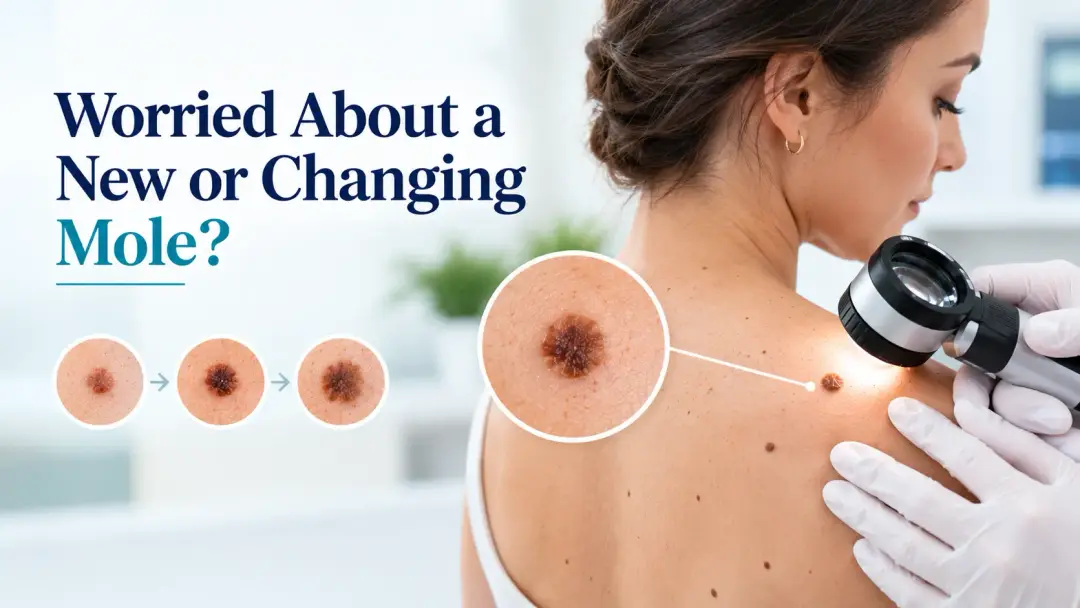
Get a changing mole checked by a healthcare professional as soon as you notice the change. Many changing moles turn out to be harmless, but only an in-person exam, and sometimes a biopsy, can tell you which kind you have.
In London, Ontario, you can start with a family doctor, a dermatologist referral or a nurse practitioner at South London Mole Clinic.
This guide is general information, not medical advice.
TL;DR
Change is the main reason to get a mole looked at, even when the mole looks ordinary.
Slow change over many years is less worrying than change over weeks or months.
Bleeding, pain, infection signs or fast growth need prompt in-person care, not a routine booking.
Take dated photos while you wait, and do not pick, cut or treat the mole yourself.
At South London Mole Clinic, you can book mole mapping without a referral. It costs $695 + HST and OHIP does not cover it.
Is a Changing Mole Dangerous?
A changing mole is not always dangerous, but change is the one sign clinicians never want you to ignore.
A stable mole tells a quiet story. It has looked the same for years.
A mole that changes behaves differently from before. That difference is what a clinician wants to assess.
Many changing moles are harmless, but you cannot tell by looking
You cannot sort a harmless change from a worrying one by eye.
Many changes have simple causes. In some cases, though, a change is an early sign of skin cancer, including melanoma.
Even trained clinicians use magnification, your history and sometimes a lab test to decide. A mirror and a good guess cannot do that job.
Normal change vs worrying change
Speed, pattern and symptoms help separate the two, but none of them gives a final answer.
Often less concerning | Worth checking promptly |
|---|---|
Change over many years | Change over weeks or months |
Whole mole fades or flattens evenly | One part grows or darkens unevenly |
Looks like your other moles | Stands out from your other moles |
No symptoms | Itching, bleeding, crusting or pain |
Treat this table as a guide, not a diagnosis. A slow change can still deserve a look.
Example: You notice a mole on your calf looks a little paler than it did years ago. That alone is a softer signal. If a mole on your back darkened on one side over two months, that is a stronger reason to book soon.
Why a mirror check is not enough
Self-checks help you notice change, but they cannot confirm what the change means.
A mirror cannot show what lies just beneath the surface.
Your back and scalp are hard to see.
Memory blurs small shifts in size and colour.
An exam and, in some cases, a biopsy give you the actual answer.
Which Changes in a Changing Mole Should Worry You?
Look for change in size, shape, colour, texture or symptoms, and for any mole that does not match your others.
The ABCDE guide
ABCDE is a simple checklist that helps you describe what you see.
Letter | What you may notice |
|---|---|
Asymmetry | One half does not match the other |
Border | Edges look ragged, notched or blurred |
Colour | Several shades in one mole |
Diameter | Wider than a pencil eraser, about 6 millimetres |
Evolving | Any change over time |
The Canadian Dermatology Association and the Canadian Cancer Society both explain these signs.
Evolving is the letter that matters most for this topic. A mole can pass the first four checks and still change.
1. The ugly duckling sign
A mole that looks different from the rest of your moles deserves a closer look.
Look at your moles as a group. Most of them share a pattern.
The odd one out may be darker, larger, paler or shaped differently. That difference matters even if it breaks no ABCDE rule.
Example: You have a dozen small, even brown moles. One has a darker patch on its edge. It stands out from the family, so mention it at your visit.
2. Symptoms that matter
New symptoms in a mole that never had any are a reason to get it seen.
Itching that keeps coming back.
Bleeding without an obvious cause.
Crusting or an open area.
Pain or tenderness.
A spot that does not heal.
3. A new mole in adulthood
A brand-new mole that appears and keeps changing deserves the same attention as an old mole that changes.
Read this guide to the early signs of skin cancer for more on what to watch.
Pro tip: Check your skin once a month after a shower. Use a hand mirror for your back, and ask a partner to look at your scalp.
When Should You Get a Changing Mole Checked?
Get it checked as soon as you notice the change, and let what the mole is doing decide how urgent it feels.
Level | What you notice | What to do |
|---|---|---|
Prompt care | Bleeding, pain, infection signs, rapid growth, sudden change | See a clinician in person promptly |
Book soon | Change in size, shape or colour, or a mole that stands out | Book an assessment |
Plan ahead | Many moles or risk factors | Book mole mapping for a baseline |
See someone promptly
Some changes should never wait for a routine appointment.
Bleeding with no clear cause.
Pain or tenderness.
Redness, swelling or other signs of infection.
Fast growth or a sudden change.
Anything unclear that worries you.
Do not wait for a mole mapping slot in these cases. Mole mapping tracks change over time. It does not replace urgent care.
Book soon for a steady change
A noticeable change in size, shape or colour is reason enough to book.
A mole that is slowly getting bigger.
A colour shift, or a second shade appearing.
A raised area on a mole that was flat.
One mole that no longer matches the others.
Example: A mole on your shoulder looks a little wider than last summer. Nothing hurts or bleeds. Booking an assessment now is sensible, and you do not need to wait for it to get worse.
Book ahead if you have risk factors
Some people benefit from a baseline before any mole changes.
50 or more moles, or moles that look large or irregular.
You or a close relative had melanoma or another skin cancer.
Fair skin, freckles or red hair, and you burn easily.
Heavy childhood sun, past sunburns or tanning bed use.
Moles in spots you cannot easily see, like your back or scalp.
A weakened immune system, or medication that lowers immunity.
A high mole count raises questions, but type and change often matter more. This guide on how many moles is too many explains why. You can also read about the dysplastic nevus, an atypical mole that clinicians monitor.
What if your moles keep changing?
Frequent changes across several moles still deserve an assessment, and a documented baseline makes them far easier to sort.
When many moles seem to shift, memory fails. You cannot tell which change is new.
Photograph the moles that worry you most.
Write down when you noticed each change.
Book an assessment instead of waiting to see what settles.
Ask about mole mapping, which lets us compare images side by side at each visit.
Many people return for mole mapping every 6 to 12 months. Your nurse practitioner suggests the timing that suits your risk. Our guide on why early skin cancer detection matters explains the reasoning.
What to Do While You Wait for Your Appointment
Document the mole, protect it from irritation and avoid anything that could change it further.
Photograph it
Wash and dry the area.
Place a ruler or coin beside the mole for scale.
Take one close photo and one wider photo that shows where it sits.
Use the same light and distance each time.
Save the photos with the date.
Pro tip: Daylight near a window gives the truest colour. Bathroom lights often distort it.
Write down what changed
When you first noticed the change.
What changed: size, shape, colour, height or feel.
Any itching, bleeding or pain.
Whether anyone in your family had skin cancer.
Bring the notes and photos to your visit. They give the clinician a timeline that memory cannot.
What not to do
Do not try to deal with the mole yourself.
Do not pick, scratch or cut it.
Do not use home remedies, acids or removal creams.
Do not shave over it.
Do not rely on an app to decide whether to book.
Do not wait for it to settle on its own.
Who Can Check a Changing Mole in London, Ontario?
Method | Pros | Cons |
|---|---|---|
Family doctor or walk-in clinic | Easy first step for one worrying mole. Can refer you on. May follow the OHIP pathway if eligible. | Availability and waits vary. May add a referral step for a specialist. |
Dermatologist | Specialist skin care. Useful for complex or unclear concerns. May follow the OHIP referral pathway if eligible. | Usually needs a referral first. Intake and wait times can vary. |
Nurse practitioner-led clinic (South London Mole Clinic) | Direct booking, no referral. Photo baseline for future comparison. Nurse practitioner explains the next step. | $695 + HST, not covered by OHIP. Mole mapping is not diagnostic, so you may still need a biopsy or referral. |
Apps and online photo checks | Convenient, any time. Helps you keep a dated photo record. | Cannot diagnose a mole. Poor light and camera quality hide detail. A "low risk" result can give false comfort. |
You can start with a family doctor, a dermatologist or a nurse practitioner-led clinic, and the best fit depends on how you want to access care.
1. Family doctor or walk-in clinic
A family doctor or walk-in clinic can look at a mole and refer you on if needed. Availability and waits vary, so call ahead.
2. Dermatologist
A dermatologist visit usually starts with a referral from a primary care provider.
Ask the office whether they are accepting referrals and how long intake takes.
Our comparison of a private mole clinic and a dermatologist referral in Ontario walks through both paths.
3. Nurse practitioner-led clinic
A nurse practitioner-led clinic lets you book directly without a referral.
South London Mole Clinic is nurse practitioner-led and was founded by Pinkal Gandhi. We sit on Southdale Rd E in London.
You book mole mapping directly.
We go over your skin history and the moles on your mind.
If something looks worth a closer check, your nurse practitioner explains the next step. That may be a biopsy or a referral.
4. Apps and online photo checks
Apps can help you track a mole, but they cannot diagnose it.
Photo quality and lighting limit what an app can show. Use one to keep a record, then bring that record to a clinician.
What Happens When You Get a Changing Mole Checked?
A check is quick, private and painless, and you leave knowing the next step.
1. The conversation
We start by talking. We ask about your skin history, your risk factors and the mole that worries you.
Tell us what changed, when it changed and whether it causes symptoms.
2. A closer look with dermoscopy
Digital dermoscopy shows detail just beneath the surface of a mole. We use polarised light at high magnification.
Nothing breaks your skin. A small handheld dermoscope rests gently on the surface.
Your mole mapping appointment
At South London Mole Clinic, the visit follows four steps:
We talk first. We review your history, risk factors and moles of concern.
Total body imaging. Our IntelliStudio system takes high-resolution photos across your skin.
Digital dermoscopy. Moles worth a closer look are captured under magnification.
Your baseline. We store your images securely and privately for comparison at future visits.
Most visits take about 30 to 45 minutes, depending on how many moles we document. The visit involves no radiation.
How to prepare:
Come with clean skin, and skip makeup, foundation and nail polish.
Leave self-tanner off for about two weeks before.
Take off jewellery and tie long hair back.
Wear underwear you feel comfortable being photographed in.
Skip dark socks, and shave areas where hair hides the skin if you can.
Note the moles you want us to look at.
Possible outcomes
Your nurse practitioner explains the result and the next step, and the next step depends on what we find.
Monitor: keep watching and compare at your next visit.
Biopsy: a small sample goes to a lab, which is how a diagnosis is confirmed.
Referral: you move to further assessment.
Removal: a separate procedure when a mole needs to come off.
Learn more about mole removal in London, Ontario or our mole removal service.
How Mole Mapping Helps a Changing Mole (and Where It Stops)
Mole mapping helps you track a changing mole over time, but it is not a diagnostic test.
What it helps with
It builds a clear photo baseline of your moles.
It shows new moles and changes in existing ones side by side.
It records spots you cannot easily see yourself.
It replaces guesswork with a documented record.
What it cannot do
It cannot diagnose skin cancer.
It does not replace a clinical skin exam or a biopsy.
It does not replace urgent care for bleeding, pain, infection, sudden change or rapid growth.
Mole mapping is a monitoring and record keeping tool. Read more on our mole mapping and digital skin imaging page.
How Much Does a Mole Check Cost in London, Ontario?
Mole mapping at South London Mole Clinic costs $695 + HST, paid when you book, and OHIP does not cover it.
Pathway | Cost note |
|---|---|
Family doctor or walk-in clinic | May follow the OHIP pathway if eligible |
Dermatologist | May follow the OHIP referral pathway if eligible |
South London Mole Clinic mole mapping | $695 + HST, private pay |
Ask each provider to confirm eligibility and fees before you book.
Some extended health plans may reimburse mole mapping. Ask your insurer before you book.
Our guides explain more about whether mole mapping is covered by OHIP and the mole mapping cost in London, Ontario. You can also view our pricing page.
Changing Mole FAQs
1. My mole is changing. When should I get it checked?
Get it checked as soon as you notice the change. See a clinician promptly if it bleeds, hurts, grows fast or changes suddenly.
2. Is a changing mole always cancer?
No. Many changing moles are harmless. Only an exam, and sometimes a biopsy, can tell which kind you have.
3. Is there any risk in a changing mole?
In some cases, a change is an early sign of skin cancer, including melanoma. Checking sooner lets a clinician look sooner, which is why we advise against waiting.
4. Do I need a referral to get a changing mole checked?
Not for mole mapping at South London Mole Clinic. A dermatologist visit usually starts with a referral from a primary care provider.
5. What can I do if my moles keep changing?
Photograph them, write down what changed and book an assessment. Mole mapping gives you a baseline, and many people return every 6 to 12 months.
Book a Mole Check at South London Mole Clinic
If a mole is changing and you want a clear baseline, you can book mole mapping directly with our nurse practitioners.
Call (519) 800-4518
Contact us with questions
Visit us at 561 Southdale Rd E #10, London, ON N6E 3M2
Want to read more first? Start with why early skin cancer detection matters.
Mole mapping is not a diagnostic test, and whether it suits you depends on a clinical consultation. See a healthcare professional in person promptly for pain, bleeding, infection, sudden change, rapid growth or unclear symptoms.